
Portalz Pty Ltd Portalz

Systemic Cryptographic
Failure Insurance

Addressing the consequences of emerging cryptographic threats that can catastrophically escalate due to shared cryptographic dependencies (monoculture).

To the Board
Re: Exposure to systemic cryptographic failure and insurance uncertainty

Modern digital infrastructure relies on a narrow set of globally deployed cryptographic standards. This concentration has created a class of risk that is not well represented in conventional cyber breach models.

Current post-quantum planning focuses primarily on securing key exchange. It does not provide a comprehensive response to systemic failure of widely used symmetric cryptographic foundations such as AES.

What is your organisation’s exposure to systemic cryptographic failure, and does your current insurance programme explicitly address that exposure?
Why this matters

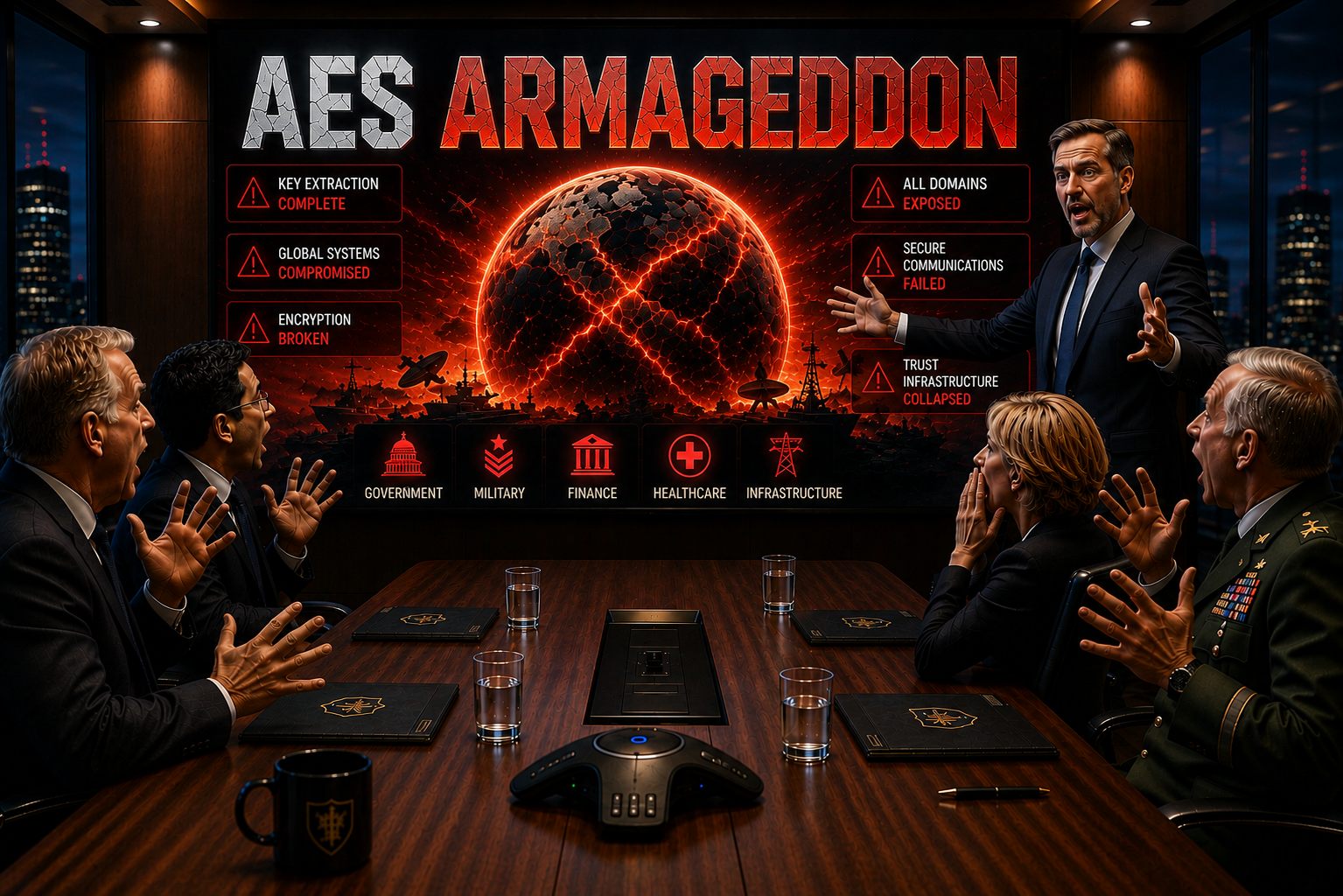
This is not a routine breach scenario. It is a failure class in which confidentiality, integrity, and authenticity may be degraded simultaneously across multiple dependent systems due to shared cryptographic dependencies embedded across infrastructure.

In practical terms, this means that systems assumed to be independent may fail together. Data protection, identity validation, device trust, and transaction integrity all rely on the same underlying cryptographic standards. If those standards fail, the separation between systems collapses.

Unlike conventional breach incidents, this type of event does not unfold gradually. It can manifest as a step-change in exposure:

The consequence is not only a breach, but a loss of trust in the systems used to assert confidentiality and authenticity. This shifts the impact from an operational incident to a systemic event affecting multiple departments and organisations at once.

Precedence and current status

Cryptographic standards have historically transitioned when effective security margins eroded. The deprecation of DES (56-bit) followed demonstrated practical breakability as computing capability increased.

Current quantum models (e.g., Grover’s 1996 algorithm) reduce the effective security margin of symmetric ciphers under quantum computers. Under those assumptions, AES-128 is assessed to provide a materially reduced margin under Grover's relative to its classical strength, prompting industry guidance to recommend AES-256 for quantum era protection.

This shift reflects a parameter adjustment rather than a change of primitive, and its adequacy depends on the completeness of the underlying threat model.

As Grover's reduces key-space from 128 to 64 bits, approaching the key-space of legacy DES at 56 bits, it indicates that AES is not quantum safe in it's most widely used format.

Current NIST advice is that AES-256 bit is quantum safe for decades, but that assumes that Grover's is the only quantum threat algorithm. This does not address the core capacity of quantum computers to simultaneously access all combinations of a 256 bit key-space that would otherwise take billions of years.

These factors shift the cryptographic failure event risk profile from unlikely + catastrophic to uncertain + catastrophic.

Insurance relevance

If this class of failure is foreseeable yet undefined in policy language, it may represent an unpriced or partially uninsurable accumulation risk. That has direct implications for governance, due diligence, and internal mitigation planning.

Board-level question

Has the organisation formally assessed whether its cyber or broader insurance arrangements cover a systemic cryptographic failure event arising from compromise of widely deployed encryption standards?

To find out more: