FES Papers
Convenient FES Summary Papers.
FES Arrives
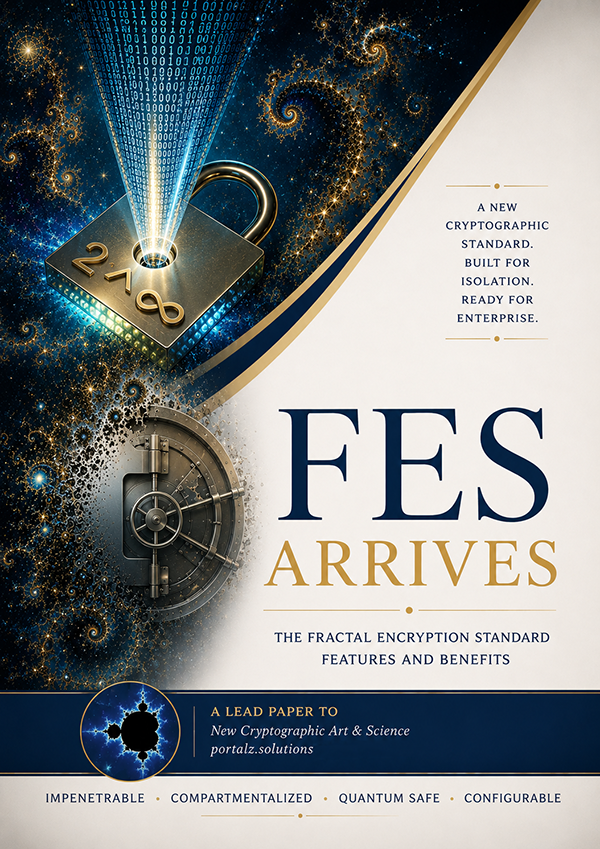
Features and benefits unique to FES
This paper introduces the mature FES standard and its principal architectural innovations, including private cryptographic foundations, configurable dimensional key-space, Dominion management, Fractal OTP, integrated hashing and hybrid AES compatibility. It also summarises the analysis supporting FES's resistance to both classical and quantum attack models and its practical implementation of Shannon's conditions for perfect secrecy.
FES is supported by a comprehensive technical library, mathematical analyses, validation papers and live demonstrations. Each major component of the architecture has been documented independently to allow transparent technical review.
FES does not represent an incremental enhancement to existing symmetric encryption. It introduces a new cryptographic architecture whose principles, implementation and supporting analyses are presented for independent examination.
The FES Journey
It started nowhere near cryptography.
My background is systems analyst and enterprise architect with 40 years of professional experience.
I did not set out to develop new encryption, that is not my background, it was my Galaxonomy project that lead to my studying fractals to solve an ID problem. I did solve it there!
I noticed several qualities in the fractal field that I had not encountered previously and began to investigate. A potential encryption methodology began to emerge over a 12 month period.
The first time it all came together was on holidays in Yamba NSW, when I coded and tested the first fractal transformation prototype in 2021.
The story of how FES became the standard you see today is not as a single arrival, but a continuous run of discovery, innovation, research, and bloody-minded, persistent curiosity, each piece resting on the one before it.

A Note to Cryptographers
I am not a career cryptographer.
My understanding of cryptography has been acquired through decades of practical application, independent study, and, ultimately, the development of FES itself. As a consequence, my language may not always reflect established cryptographic convention, nor may I always describe concepts using the terminology familiar to specialists.
My background is that of a software engineer, systems analyst, enterprise architect and inventor. I naturally think in terms of systems, structures, navigation and visual relationships. Consequently, FES is described in ways that may appear unconventional to readers accustomed to algebraic notation and traditional cryptographic discourse.
Readers will also encounter terminology that is uncommon in cryptography, including expressions such as fractal portal, fractal stream, fractal navigation and 2^infinity. These terms were not created to replace established cryptographic language, but to describe behaviours and structures that emerged naturally during the development of FES. They form part of the framework's internal model and provide a concise vocabulary for concepts that, in the inventor's view, are not adequately captured by conventional terminology.
This is not intended to challenge the discipline's language or rigor. On the contrary, it reflects the path by which the invention emerged. As my understanding of cryptography has deepened, I have adopted established terminology wherever practical, while occasionally retaining descriptions that better capture the underlying behaviour of FES.
The language of FES has continued to evolve as the inventor's understanding of cryptography has deepened. While terminology may change, the underlying invention has remained remarkably consistent from its earliest formulations.
Go Deeper — Portalz Library
- Master Paper — The full FES architectural map
- FES Silos — Cryptographic compartmentalisation
- Stage 1: Input Layer — Portal discovery and password destruction
- Stage 2: HFN — Stream emergence
- Stage 3: Overwrite Layer — Whole-of-payload transformation
- HFN Theory — The navigational mathematics
- FES Impenetrability — Logical impossibility
- FES + AES — The hybrid architecture