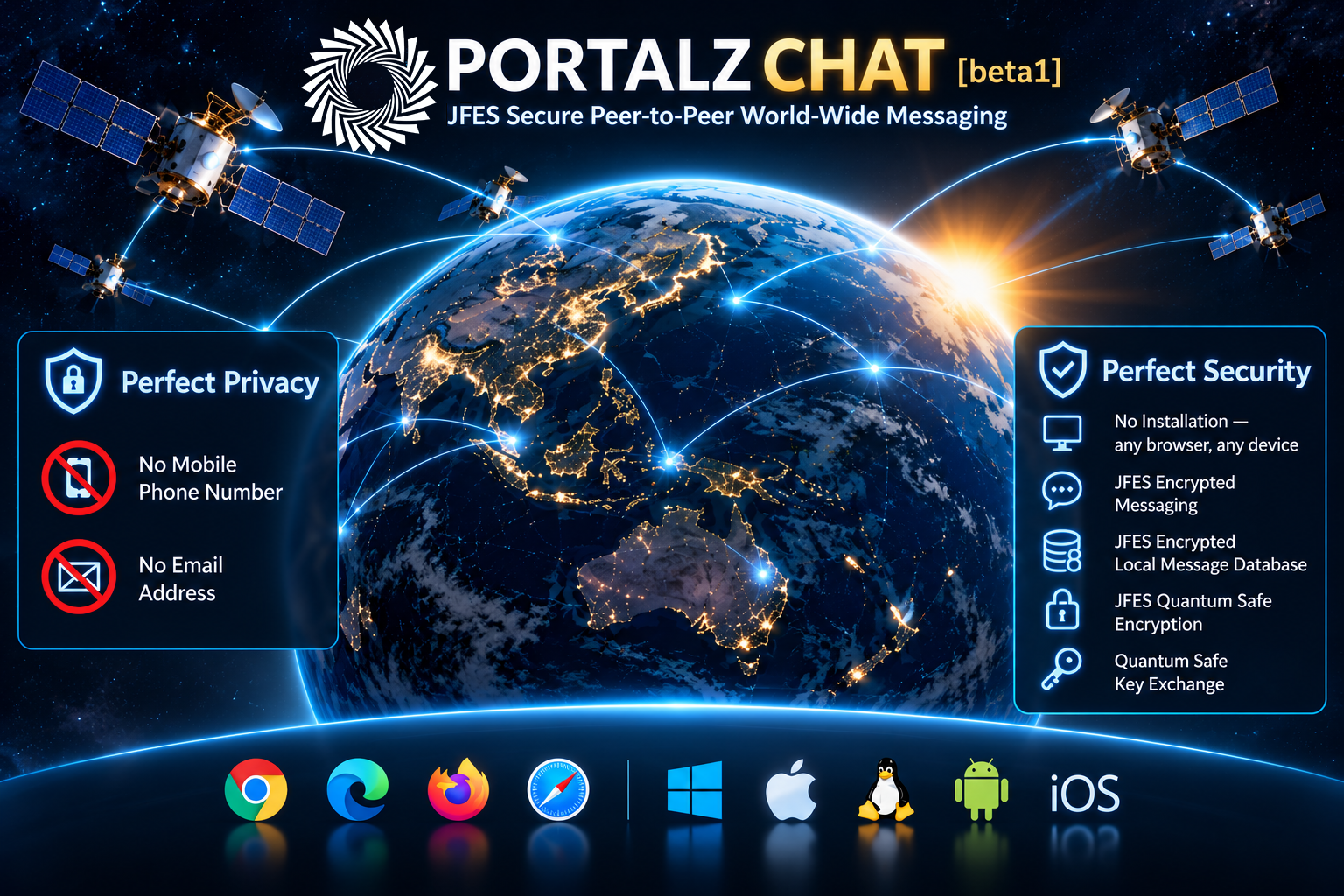
Portalz Chat Has Arrived
Portalz Chat is a browser-native secure messaging system designed around peer-to-peer communication, JFES encrypted messaging, encrypted local message storage, and quantum-safe key exchange.
no phone number, no application installation, no platform lock-in, and no requirement to move the conversation through a central messaging server.
No Installation
Open Portalz Chat in a modern browser. The application runs in the browser rather than requiring a native application install.
Peer-to-Peer
WebRTC provides the communications transport, with ICE used to discover and select a viable network path between peers.
JFES Security
Messages are protected using the JavaScript Fractal Encryption Standard, extending the Portalz FES architecture into the browser.
Perfect Privacy
Privacy begins before a message is ever sent. Portalz Chat does not require the two most common personal identifiers used by conventional messaging services.
No Mobile Phone Number
Portalz Chat does not require a mobile phone number to establish your messaging identity.
No Email Address
Portalz Chat does not require an email address to establish your messaging identity.
Perfect Security
The beta1 system combines browser-native messaging with the Portalz cryptographic architecture.
JFES Encrypted Messaging
Message payloads are encrypted using JFES. JFES performs whole-of-payload transformation rather than conventional fixed-size block processing.
JFES Encrypted Local Message Database
Local message persistence is encrypted. The browser stores the protected message database rather than an exposed plaintext conversation history.
Quantum Safe Encryption
Portalz Chat uses JFES as its payload-encryption layer, providing the Portalz quantum-safe encryption architecture within the browser application.
Quantum Safe Key Exchange
Portalz Chat uses a hybrid X25519 + ML-KEM-768 key-establishment design for session key exchange.
Worldwide Connectivity
WebRTC ICE supports direct peer connectivity across real-world network conditions. TURN relay is available as network-path fallback where direct connectivity is unavailable.
Browser Native
The communications and cryptographic application is delivered as a web application, making the same Portalz Chat architecture available across supported browsers and devices.
A Different Messaging Architecture
Portalz Chat separates the cryptographic system, the messaging application, and the network path. The transport path does not become the cryptographic authority.
JFES Payload Layer
JFES is the browser implementation of the Portalz Fractal Encryption Standard. The JFES architecture applies transformation to the complete payload and uses Silo-defined fractal domains and fractal navigation.
JFES reference: portalz.solutions/jfes.html
WebRTC Transport Layer
WebRTC provides the peer transport. ICE discovers available network candidates and selects the viable path. When a direct peer path cannot be established, TURN provides relay transport without becoming the messaging cryptographic endpoint.
Security Architecture
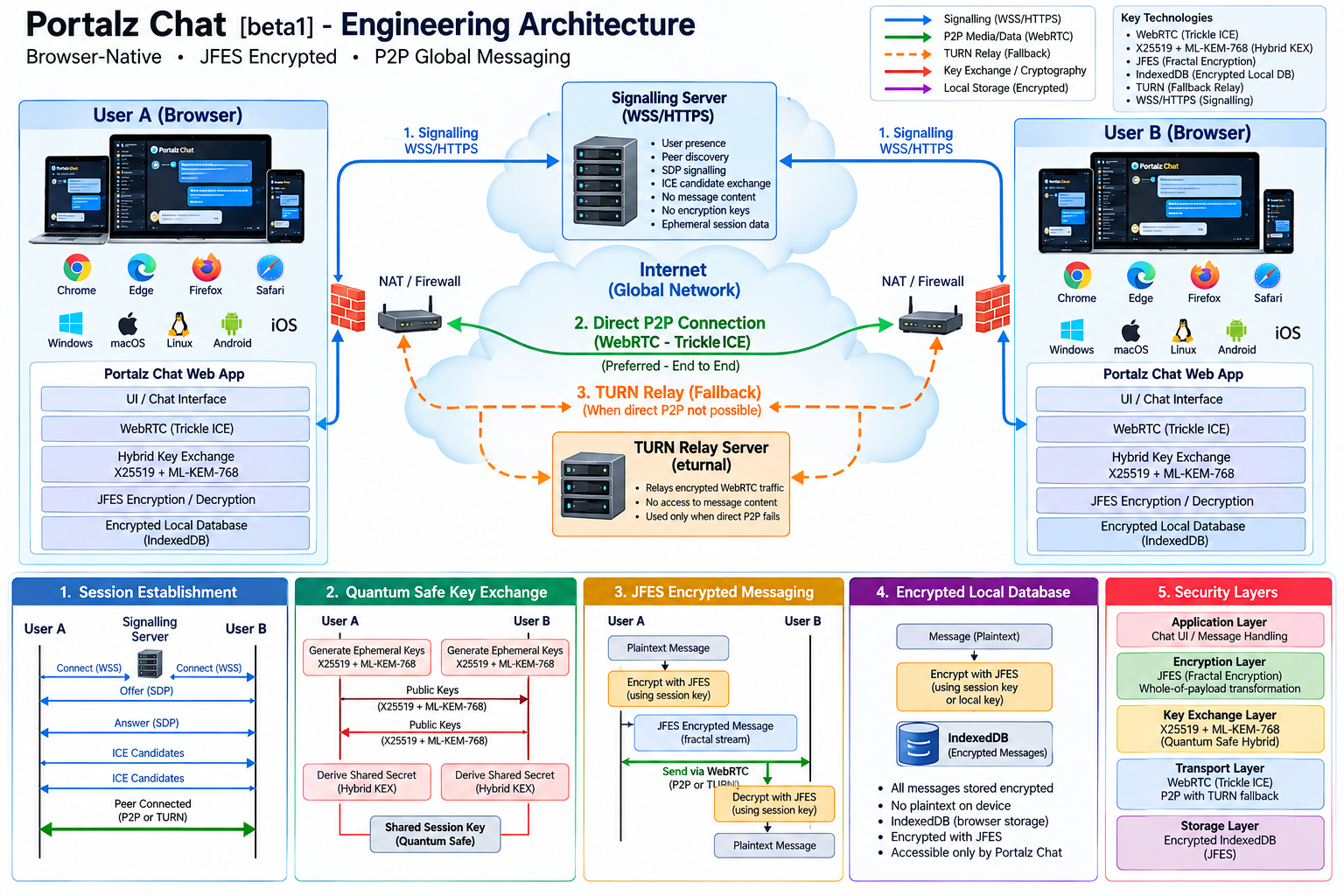
Portalz Chat combines two distinct security functions: quantum-safe session key establishment and JFES payload protection.
| Layer | Portalz Chat | Purpose |
|---|---|---|
| Key Establishment | X25519 + ML-KEM-768 hybrid | Establishes the cryptographic session material between peers. |
| Message Protection | JFES | Protects the message payload using the Portalz fractal transformation architecture. |
| Local Persistence | Encrypted IndexedDB message database | Protects stored conversation data on the device. |
| Network Transport | WebRTC / ICE | Provides browser-native peer communication and network path selection. |
| Relay Fallback | TURN / eturnal | Relays packets when direct peer connectivity is unavailable. |
True Browser-to-Browser Communication
Portalz Chat implements a browser-based P2P architecture.
Direct P2P
Where network conditions permit, WebRTC establishes a direct peer connection. The message path is browser-to-browser.
TURN Relay Fallback
TURN supplies an alternative network path when direct connectivity cannot be established. The same protected PChat payload traverses either path.
Encrypted Local Message Database
Portalz Chat does not treat the browser's local message store as an unprotected archive.
Browser Persistence
Conversation data can persist locally in IndexedDB for continued use between browser sessions.
Encrypted Storage
The local PChat message database is encrypted rather than being maintained as a plaintext conversation store.
Device-Native
The local database remains associated with the browser/device environment rather than requiring a central message-history database.
Any Browser. Any Device.
Portalz Chat is designed as a browser application rather than a platform-specific messaging client.
Browsers
Chrome Edge Firefox Safari
Operating Systems
Windows macOS Linux Android iOS
Portalz Chat [beta1]
FJES Secure Peer-to-Peer World-Wide Messaging
Built on World-First Shannon OTP Compliant FJES Encryption
Portalz Chat → JFES →