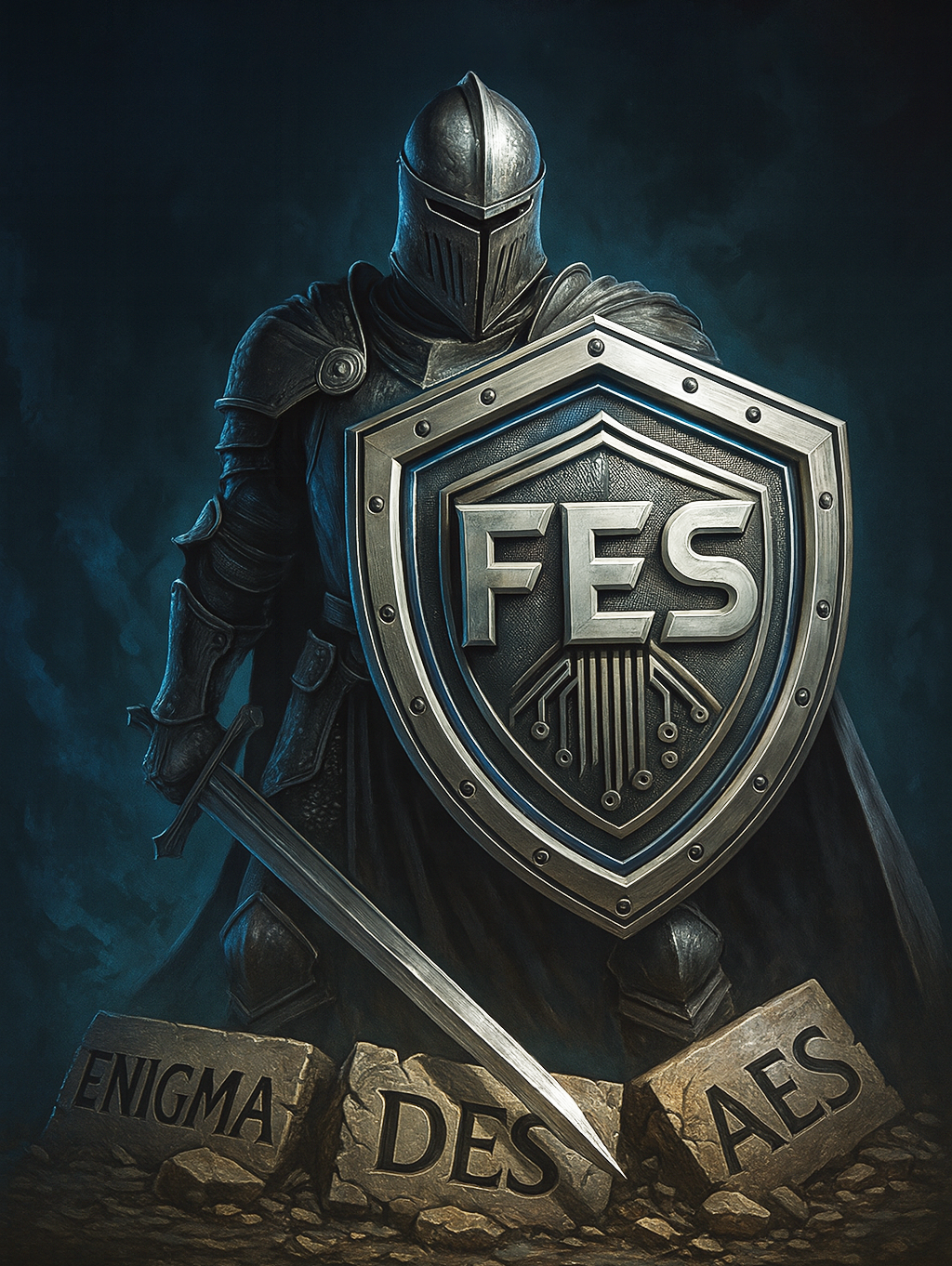
Fractal Encryption Standard (FES)
Features:
- Irreversible encryption architecture
elimiates reversibility, enumeration, and key-derivation. - Data Finality
for environments that require finality beyond reversible cryptography.
Benefits:
- Data finality – no recoverable data structure to harvest or decrypt.
- Non-enumerable outcomes – no privileged single “correct” plaintext relationship.
- Non-key-derivable – removes key derivation as a leverage point.
- Silo isolation – unlimited cryptographic compartmentalisation.
- Shannon-aligned – to classic perfect secrecy proof.
- FES + AES – seamless compliance + finality, rather than replacement.
Live FES Encryption Demonstration:
What Makes FES a Standard?
FES defines a strict and optimized implementation of Fractal Transformation (FT), ensuring encryption consistency, repeatability, and cross-platform compatibility. While FT allows for a vast range of configurations, FES provides a structured and tested set of formulas, structures, and security options, making it a practical and deployable cryptographic standard.
FES ensures:
- High-performance encryption designed for real-world applications.
- Repeatability and compatibility across different implementations.
- Scalable encryption options while maintaining standardization.
- Cross-platform integration for enterprise, government, and defense applications.
How FES Ensures Standardization
FES achieves standardization by defining and controlling key parameters within its framework:
- Fixed and tested formulas – only optimized, security-verified formulas are implemented.
- Fixed processing order – transformation & encryption follows a uniform process order.
- Fixed Fractal Stream & Transformation options – all implementations of FES will yield identical encryption results when using the same options.
While Fractal Transformation is a very broad and flexible new cryptographic science, FES provides a defined, consistent, and scalable standard that ensures both security and ease of deployment. FES is the standardised configuration of Fractal Transformation.

Impenetrable Encryption
| Features | Benefits |
|---|---|
| Logical Impenetrability | Survives post quantum security era |
| Redefines Cryptographic Security | Impenetrable algorithms are now available |
| Prevents Quantum Key Extraction | Reestablishes confidence in secure systems |
| Impenetrable Security Foundation | Builds fully quantum-proof security stack |
| Not reliant on computational difficulty | Ensures mathematically future-proof encryption |
The Quantum Security Era
requires Impenetrability
Impenetrability through Fractal Geometry and Infinity
The Fractal Encryption Standard (FES) is a new cryptographic branch that achieves true impenetrability by deriving secrecy not from computational difficulty but from fractal geometry and fractal infinity.
The password or key is used once to locate a fractal portal in a configurable multi-dimensional Mandelbrot manifold and is then discarded.
An emergent Fractal Stream transforms the payload; there is no fixed block size and the stream adapts to payload length and passes.
Under these dynamics FES satisfies all three of Shannon’s one-time pad (OTP) requirements in a practical, automatable framework, producing ciphertext in which every bit combination is equally probable.
-
Revolutionary Fractal Encryption Standard
The Fractal Encryption Standard (FES) is a new cryptographic branch that achieves true impenetrability by deriving secrecy not from computational difficulty but from fractal geometry and fractal infinity.
Logical Impenetrability — The Cryptographic Consequence
While FES derives its strength from fractal geometry and infinite-complexity navigation, the cryptographic consequence of these dynamics is what we call logical impenetrability. This property goes beyond computational hardness: it ensures that no attacker—classical, quantum or otherwise—can determine the correct plaintext or key from a captured ciphertext.
In conventional encryption systems such as AES, only the correct key produces sensible plaintext. This behaviour acts as a correct-key oracle that both classical and quantum attacks can exploit. FES eliminates this oracle entirely. Due to the vast entropic environment created by the Fractal Stream, a large number of different keys can yield sensible or semi-sensible plaintexts, all of which appear equally likely.
This aligns with Shannon’s one-time pad theory, which proves that true secrecy is achieved when ciphertext provides no information about the underlying plaintext. FES is the first practical and automatable system to achieve this principle at scale. The result is ciphertext that is not merely difficult to attack—it is indistinguishable, unbiased and logically undecipherable.
Logical impenetrability is what makes FES immune to HNDL (Harvest Now, Decrypt Later) attacks, quantum decryption attempts, brute-force search and correctness-oracle detection. Even with unlimited computational power, attackers cannot identify which plaintext—if any—is the original.
Combine FES with AES
Use an Encrypt-then-Encrypt (EtE) Pipeline to achieve both 100% Compliance and 100% Impenetrability:
- Compliance – Auditors and integration stacks demand AES. Compliance regimes are built around it, and many supply chains require AES-based artefacts.
- Impenetrability – Encrypt the AES cipher with FES (reverse for decrypt). This provides future and quantum proof security.
-
FES + AES = Compliance + Impenetrability
AES remains the dominant compliance-standard cipher. FES delivers impenetrability through fractal geometry and fractal infinities, satisfying Shannon OTP conditions in a practical framework.
FES Gauge Instrumentation

The FES Gauge provides a direct, interactive instrument for evaluating
FES stream behaviour.
It is designed to expose structure, bias, and
predictability through both visual and statistical lenses.
Unlike conventional demonstrations, the Gauge invites active interrogation.
Parameters can be varied in real time, allowing independent observation of
how the system responds to change.
The matrix view acts as the primary structural probe, revealing spatial organisation and correlation. Compression resistance provides a practical test for exploitable structure, while statistical measures offer additional context.
This is not a presentation layer—it is instrumentation. If weaknesses exist, they will become visible.
The Future of Encryption
FES is not an upgrade—it is a new cryptographic foundation. It is the first and only encryption that is impenetrable, delivering true quantum proof encryption by expanding security from computational difficulty to include logical impossibility.
"FES is not about making encryption harder to break;
it is about making it impossible."
FES is the only future proof encryption upgrade you will ever need...
 |
Copyright © 2025 All Rights Reserved |
Contact: [email protected] |