
Multi-Dominion Cryptography
FES introduces Multi-Dominion Cryptography: a model of independent cryptographic domains, where access, meaning, and compromise cannot transfer between dominions.
A New Cryptographic Architecture
Today your classified networks rely on managing encryption keys. FES Dominion allows you to command cryptographic environments. Every mission, operation, compartment, or coalition can have its own governed cryptographic domain, centrally authorised, immutable once activated, and able to evolve without disrupting operations. It shifts cryptography from key administration to operational command."
Multi-Dominion Cryptography is the architectural expression of FES compartmentalisation.
Conventional encryption protects data inside a shared cryptographic monoculture (mostly AES). FES tightens that model by creating independent cryptographic dominions: isolated transformation realities where access, meaning, and compromise do not carry across boundaries.
This is not access control, policy wrapping, key branching, or namespace separation. It is cryptographic separation and isolation as a native property of the encryption substrate.
It prevents compromise from becoming universal.
Dominion Hierarchy
FES Multi-Dominion Cryptography enables hierarchical cryptographic structures that directly reflect real-world organisational security models.
Dominions are not designed in isolation. They can be organised into structured hierarchies, where higher-level dominions define and secure the domains beneath them.
This allows cryptographic architecture to mirror organisational structure: corporate divisions, departments, classifications, jurisdictions, and operational compartments.
- Corporate
- → Finance
- → HR
- → R&D
Existing organisational boundaries define responsibility, access, and risk.
- DOM: Corporate
- → DOM: Finance
- → DOM: HR
- → DOM: R&D
Each domain becomes an independent cryptographic dominion within a secured hierarchy.
Hierarchy is not merely structural. It is cryptographic. Higher-level dominions define the secure context in which lower-level dominions operate.
FES enforces them as structured cryptographic dominions.
From Algorithms to Dominions
The separation achieved between classical encryption algorithms provides a useful reference point for understanding FES Multi-Dominion Cryptography.
In conventional cryptography, each algorithm defines its own transformation space. Ciphertext produced by one algorithm cannot be interpreted by another.
- AES
- Twofish
Ciphertext produced by AES cannot be decrypted by Twofish, and vice versa. The transformation spaces are independent.
- DOM #1
- DOM #2
Ciphertext produced in one dominion cannot be interpreted in another. Each dominion defines an independent transformation space.
The key insight is not the algorithms themselves, but the effect: complete non-transferability and isolation of meaning between transformation spaces.
FES generalises this effect. Instead of a small, fixed set of algorithms, FES provides an unlimited number of independent dominions, each with the same separation property.
FES extends that separation to an unlimited set of independent cryptographic dominions that you can generate as required.
The Universal Cipher Problem
Modern digital infrastructure depends on a narrow set of universal encryption standards. This universality delivers interoperability, but also creates global structural exposure.
When many systems rely on the same algorithmic foundation, attack research scales globally. A single breakthrough against a universal cipher can propagate across all systems that share it.
Encryption monoculture is therefore not merely a technical detail. It is a global structural risk.
What is a Dominion?
A Dominion is an independent & isolated fractal transformation domain.
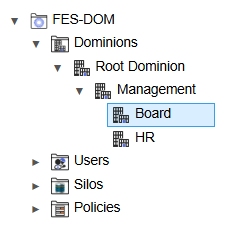
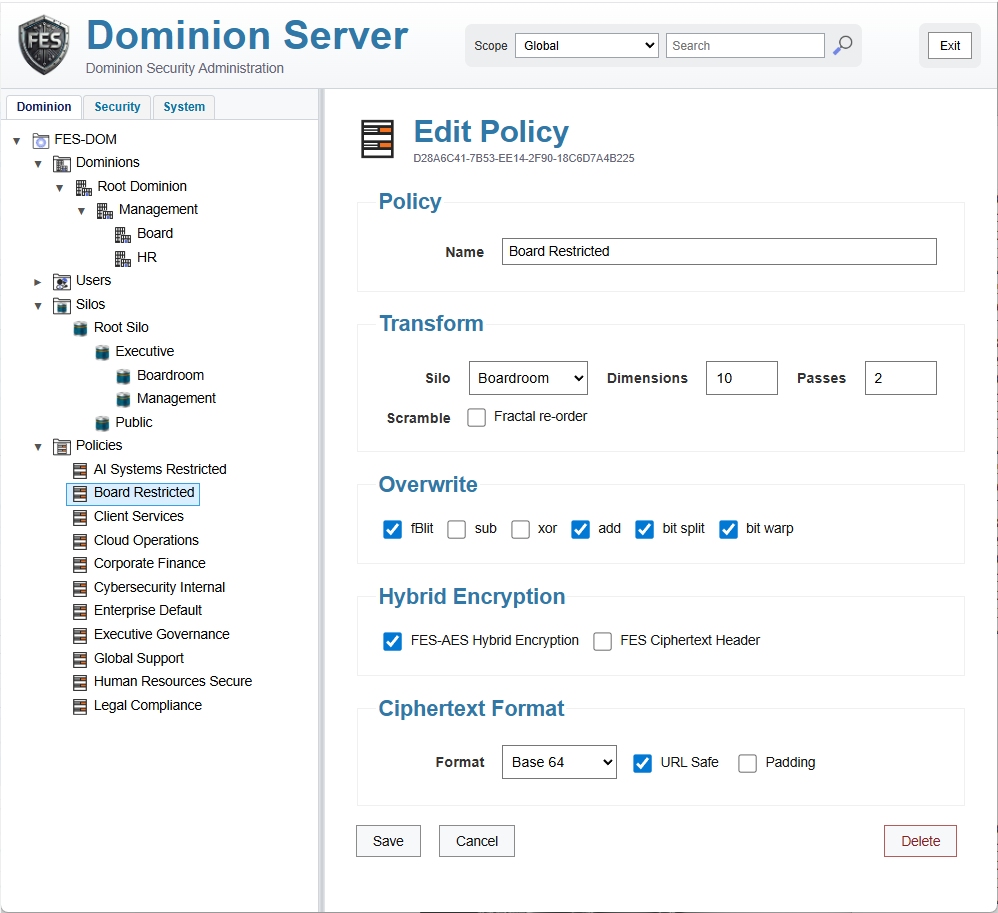
Each Dominion references a Policy that configures all FES options and Silo:
The FES Runtime DLL is configured with Dominion Runtime XML generated by the Dominion Server:
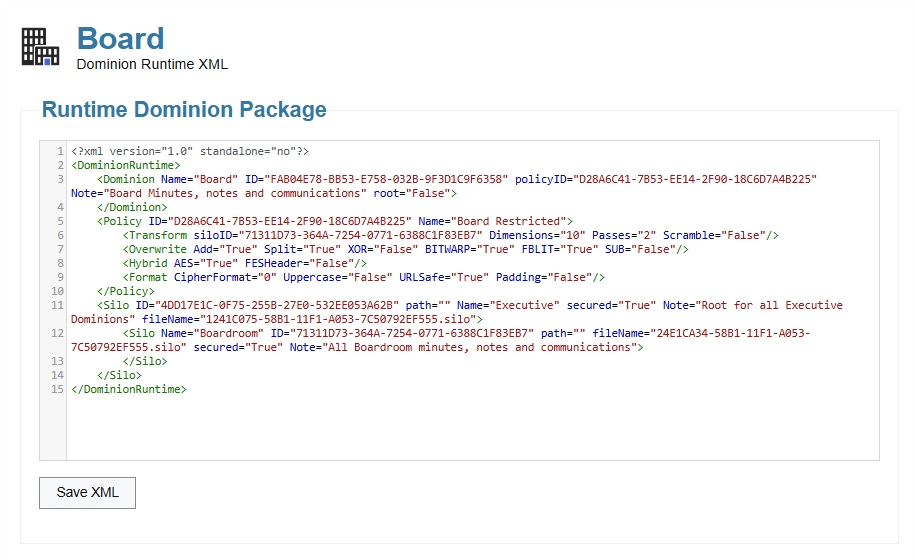
The Runtime DLL can access the Dominion Runtime XML and corresponding Silo directly from the Dominion Server by Dominion ID if it can connect to the Runtime DLL over your network (preferred). The Runtime DLL can also import Dominion Runtime XML directly, from any file path or URL.
Each Dominion behaves as its own encryption regime. The ciphertext produced inside one dominion has no structural relationship to ciphertext produced inside another. The same password, payload, or operational process cannot be assumed to transfer meaning between Dominions.
No Cross-Dominion Meaning
In conventional systems, separation is often imposed through policy, clearance, network segmentation, or key hierarchy. These are overlays placed on top of a shared cryptographic foundation. At their core it is all key management and keys are easily copied, sent, stored carelessly or held inappropriately. There is no guessing how to implement a key in an AES monoculture...
FES Multi-Dominion Cryptography removes the shared monoculture surface. Crossing dominion boundaries is not privilege escalation. It is cryptographic isolation.
FES keys are general in use, but dominion-specific in effect.
Correct FES keys also require a correct dominion.
Unlimited Cryptographic Plurality
Classical cryptography gives the world one shared cipher foundation. FES can provide an unlimited supply of uniquely isolated cryptographic dominions.
Each dominion is structurally independent. Each can represent a business unit, department, clearance level, customer group, transaction domain, jurisdiction, project, device class, or operational compartment.
The result is not simply more encryption. It is cryptographic plurality: many independent realities instead of one universal attack surface.
Need-to-Know Becomes Cryptographic
Enterprises, banks, governments, and defence organisations already operate through separation: departments, clearances, divisions, jurisdictions, projects, and need-to-know boundaries.
Traditional cryptography does not naturally mirror those boundaries. It relies on key management layered over common cryptographic assumptions.
FES allows organisational structure to become cryptographic structure. A dominion can map directly to the boundary that matters.
 CorporateBusiness units can operate in independent exposure domains.
 BankingCustomer, account, transaction, or regional domains can be separated cryptographically.
 GovernmentClassification and agency boundaries can become transformation boundaries.
 DefenceOperational compartments can be isolated against lateral compromise.
The End of Global Attack Scaling
Under a universal cipher model, a successful attack can scale globally because all targets share the same cryptographic foundation.
Under Multi-Dominion Cryptography, even complete knowledge of one dominion provides no leverage against another. Attack economics collapse because success does not transfer.
An attacker no longer faces one encryption world. They face a constellation of independent, non-overlapping cryptographic dominions.
Dominion Migration and Survivability
Conventional compromise response often relies on key rotation and redistribution. When a shared foundation is in question, that can become a global operational burden.
FES introduces a higher-order resilience mechanism: dominion migration. A compromised or retired dominion can be swapped out cleanly without requiring systemic collapse or universal re-keying.
Key management remains relevant, but the combined effect of key change and dominion migration is multiplicative rather than incremental.
Quantum and Post-Quantum Significance
Quantum computation increases pressure on reversible encryption assumptions and universal cipher foundations.
Multi-Dominion Cryptography provides a structural counterweight: no universal transformation space exists to attack, no single algorithmic monoculture exists to exploit, and cryptographic plurality becomes intrinsic.
This makes FES dominions a post-universality foundation as much as a post-quantum one.
FES Dominion Magnitude
FES Multi-Dominion Cryptography eliminates the global monoculture of encryption by enabling unlimited, guaranteed unique cryptographically isolated compartmentalisation at the algorithmic level.
This is the magnitude. This is the gravity. This is the architectural exit from universal reversible cryptographic monoculture.
The Strategic Imperative
The highest strategic prize is not message decryption. It is cryptographic key extraction."
One of the highest-value strategic objectives is the recovery of cryptographic keys. Unlike recovering a single message, recovering the key provides continuing access to every protected communication using that key.
Modern military communications ultimately depend upon cryptographic systems whose security is founded upon computational difficulty. If an adversary discovers a fundamentally new method of cryptanalysis, every system sharing that cryptographic foundation immediately enters the same risk domain.
Military doctrine rejects every other form of operational monoculture. Communications, logistics, intelligence, command, and weapons are all compartmentalised to prevent a single failure becoming a strategic failure.
Cryptography should be no different.
FES introduces a fundamentally different security architecture. Computational difficulty remains one layer of protection, but it is no longer the only one. FES also introduces Logic Impossibility, whereby the ciphertext itself provides no privileged information from which the original plaintext may be logically identified.
It removes the logical foundation upon which cryptanalysis depends.
Multi-Dominion Cryptography extends that philosophy to operational command, allowing governments, defence organisations and coalition partners to operate within independently governed cryptographic domains rather than a universal cryptographic monoculture.
—not after it. FES was designed for that future."
Go Deeper — Portalz Library
- FES Silos — Cryptographic compartmentalisation in depth
- Master Paper — Full FES architectural map
- FES Impenetrability — Logical impossibility and oracle suppression
- Cryptographic Armageddon — Monoculture and systemic risk
- Quantum Key Extraction — Why quantum demands dominion separation