

| Contents | |
|---|---|
 FES-XML FES-XML |
Transformation Policy Object |
| What It Represents |
Transformation identity, not cryptographic state |
| What It Contains |
Options, silo, dimensions, overwrite, format |
| What It Does Not Contain |
No streams, state, or derived cryptographic material |
| Why FES-XML Exists |
Repeatability, governance, and portability |
| In the Framework |
Export, import, and GUID-based policy binding |
| In the FES DLL |
Single-property policy application |
| Control Plane |
Policy separation from execution |
| Offline Secure Sharing |
Using FES-XML with shared Silos |
| Protected Exchange |
Transforming FES-XML prior to distribution |
FES-XML
FES-XML is a portable Transformation Policy Object used to define how the Fractal Encryption Standard (FES) performs a transformation.
Rather than configuring individual options each time, FES-XML captures a complete, self-contained definition of a transformation — including silo selection, dimensionality, overwrite composition, and output formatting.
An FES-XML definition can be generated directly from the FES Framework UI, stored or shared as a file or clipped artifact, and later re-applied without ambiguity.
What FES-XML Represents
An FES-XML document represents the identity of a transformation, not the cryptographic state itself.
It defines what kind of transformation is performed — not the fractal stream, navigation path, or internal state that emerges during execution.
This separation allows FES to remain epistemically sealed while still supporting repeatability, governance, and controlled deployment.
What FES-XML Contains
An FES-XML definition may contain:
• Transformation identity (Name and GUID)
• Silo selection
• Dimensional configuration and pass count
• Overwrite composition (BLIT, XOR, ADD, SPLIT, BITWARP, SUB)
• Cipher output formatting options
These elements fully describe the policy under which a transformation is executed.
What FES-XML Does Not Contain
FES-XML deliberately does not contain:
• Any fractal stream data
• Any derived internal state
• Any navigation paths or portal coordinates
• Any ciphertext or entropy material
Secrets only appear in FES-XML if they are intentionally placed there by the user (for example, in an optional Input block). No hidden or derived cryptographic material is ever embedded automatically.
Optional Input Definitions
Input definitions within FES-XML are optional.
When present, Input elements (such as Password, Context, or Input data) are treated as user-supplied values that can be edited, replaced, or removed entirely.
This allows the same FES-XML policy definition to be reused across different environments, sessions, or payloads without modification to the transformation policy itself.
Why FES-XML Exists
The configuration space of FES is intentionally rich and multi-dimensional. FES-XML exists to make this complexity manageable and repeatable.
FES-XML enables:
• Repeatable transformations under identical policies
• Organisational governance and standardisation
• Safe sharing of approved transformation definitions
• Clear separation between policy and execution
FES-XML in the Framework
Within the FES Framework, FES-XML is generated and consumed through dedicated export and import operations.
Exporting FES-XML
FES-XML export is performed from an active Transformation configuration.
The export operation captures the complete transformation policy associated with the selected Options definition and serialises it as an FES-XML document.
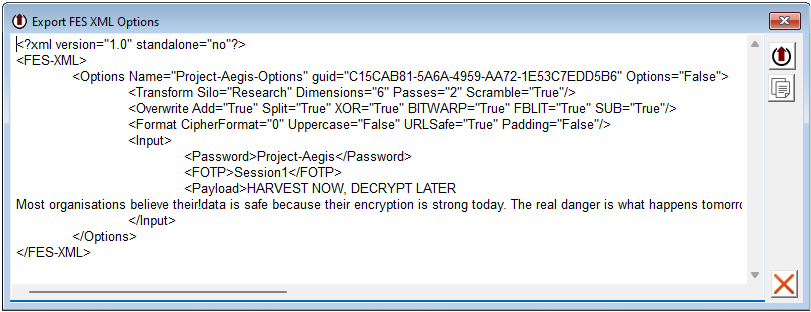
Exported FES-XML can be stored, clipped, shared offline, or transformed further as required.
Importing FES-XML
FES-XML import is accessed via the Framework MDI menu and operates independently of any currently open Transformation forms.
Imported definitions may be linked to an existing Options record using their GUID, or added as a new transformation policy within the Options database.
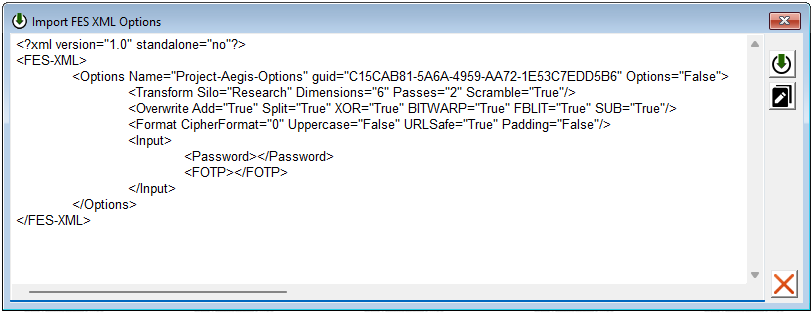
This separation allows transformation policies to be managed, curated, and reused without requiring an active transformation session.
FES-XML and the FES DLL
FES-XML is also supported directly by the FES_V2.dll.
A single OptionsXML property can be used to apply an entire transformation policy in one operation, without individually setting each option.
This allows applications to consume pre-approved transformation definitions while keeping execution logic clean, minimal, and auditable.
FES-XML as a Control Plane
Conceptually, FES-XML functions as a control plane for FES.
It defines how transformations are configured, governed, and reproduced, while the cryptographic engine itself remains sealed and non-invertible.
This separation is fundamental to FES: policy is explicit and portable, execution is opaque and irreversible.
Offline Sharing for Secure Communication
FES-XML can also be used as a lightweight, offline mechanism for defining secure communication policies between parties.
In this scenario, the FES-XML document defines the transformation policy to be used, while the participating parties share access to a common Silo.
This shared Silo may be:
• A custom-generated Silo distributed securely between parties
• The standard Public Silo included with the FES Framework installer
The FES-XML definition can be exchanged offline (for example, as a file or clipped text), allowing both sides to apply the same transformation policy without any online dependency.
The cryptographic strength remains unchanged: the Silo defines the encryption domain, while FES-XML defines how that domain is used.
Protected Policy Exchange
In higher-security scenarios, an FES-XML definition can be exchanged as a protected policy artifact.
This means the FES-XML itself is transformed prior to exchange, so the policy definition is not readable in transit or at rest outside the intended environment.
This approach can be used to:
• Prevent disclosure of policy details during offline distribution
• Support controlled release of approved transformation policies
• Treat policies as sealed artifacts that must be intentionally imported and applied
Conceptually, this creates a two-layer structure: a transformation policy (FES-XML) encapsulated inside a higher-level FES transformation.
The result is a portable policy object that can be safely distributed while remaining inaccessible without the correct environment and credentials.