1. Two Algorithms. One Global Exposure.
Thousands of security products. Millions of networks. Billions of devices. Behind this extraordinary diversity sit two dominant symmetric encryption algorithms: AES and ChaCha20.
| Security infrastructure | Common symmetric encryption |
|---|---|
| HTTPS / TLS 1.3 | AES, ChaCha20 |
| QUIC / HTTP/3 | AES, ChaCha20 |
| WireGuard | ChaCha20 |
| IPsec, SSH, OpenVPN | AES, ChaCha20 (among supported options) |
| WPA2 / WPA3 | AES in modern configurations |
| BitLocker, cloud and database encryption | AES widely deployed |
All five original TLS 1.3 cipher suites use AES or ChaCha20. Even post-quantum key establishment retains these algorithms for bulk encryption.
2. Different Algorithms. The Same Security Foundation.
AES and ChaCha20 are radically different designs. Yet both ultimately rely on the same premise: that extracting the secret key is computationally infeasible.
What happens when an attack does not merely accelerate classic computation, but extracts the key in Quantum Superposition?
Classic algorithmic diversity does not address the quantum threat.
3. The Common Cybersecurity Denominator
PORTALZ estimates that AES and ChaCha20 participate in 99% of cybersecurity stacks. The exact proportion remains to be quantified, but their dominance is unmistakable.
At the center of 99% of security stacks.
A vulnerability in one layer of the security stack threatens the whole application. A vulnerability in the cryptographic foundation can threaten entire industries, regardless of their choice of operating system, firewall or security vendor.
The common denominator is everywhere.
4. The Grover Tunnel — Shutting Down AES Quantum Discussion
Why is AES-256 considered resistant to quantum attack? The familiar answer is Grover’s algorithm, with its formidable order of 2128 sequential oracle iterations.
From 2256 to 2128 Iterations
Even at a hypothetical trillion iterations per second, that is approximately 8.5 quintillion years. Grover search is an extraordinarily unattractive route to AES-256 key extraction.
The impracticality of the Grover attack does not demonstrate the impracticality of every possible quantum attack.
Closing the Grover gate does not secure the perimeter.
5. Are We Measuring the Wrong CRQC Computer?
The same reasoning extends to the Cryptographically Relevant Quantum Computer (CRQC). Relevant to which attack?
If the hardware threshold is calculated around the enormous sequential workload of Grover, the resulting forecast describes a machine capable of running that attack. It does not establish the arrival date of a machine capable of exploiting a different quantum mechanism.
Our R&D indicates that no quantum computer can make Grover's work because there remains 2128 classic iterations that cannot be performed in Superposition. Further, Grover requires logic qubits that escalate the qubit count dramatically, reducing quantum coherence.
In contrast QKE based algorithms are entirely quantum, contain no classic iteration and are error tolerant without logic qubits. Any Quantum Computer that can configure a 128 or 256 qubit key-space addresses all possible combinations at once. It is then a matter of engineering the AES or ChaCha20 unitary function and pointing to a plaintext header.
Change the attack architecture and the Q-Day timetable must be reconsidered.
6. QKE — Full Quantum Superposition Search
Quantum Key Extraction - The QKE Tautology - starts with three foundational observations:
- A 256-qubit register represents a superposition of all 2256 candidate keys.
- AES and ChaCha20 computations can be implemented as reversible quantum operations.
- Known plaintext and other non-random constraints provide a means of discriminating candidate decryptions. Sufficient constraints can isolate the correct key.
The attackers challenge is to exploit that discrimination within the quantum system itself, rather than undertake the immense sequential workload of Grover search.
Grover accelerates classic search. QKE searches entirely in Superposition.
At Portalz we also use the term 'QKE' to describe a broad range of possible cryptographic compromise:
- Back doors: possible NSA inserted back doors
- Neural Nets: training neural nets to map from key's to ciphertext
- Quantum Neural Nets: classic trained neural net weights processed by quantum computer
- AI LLM: large language model training
- AI Petahacker: a convergence of any or all of the above
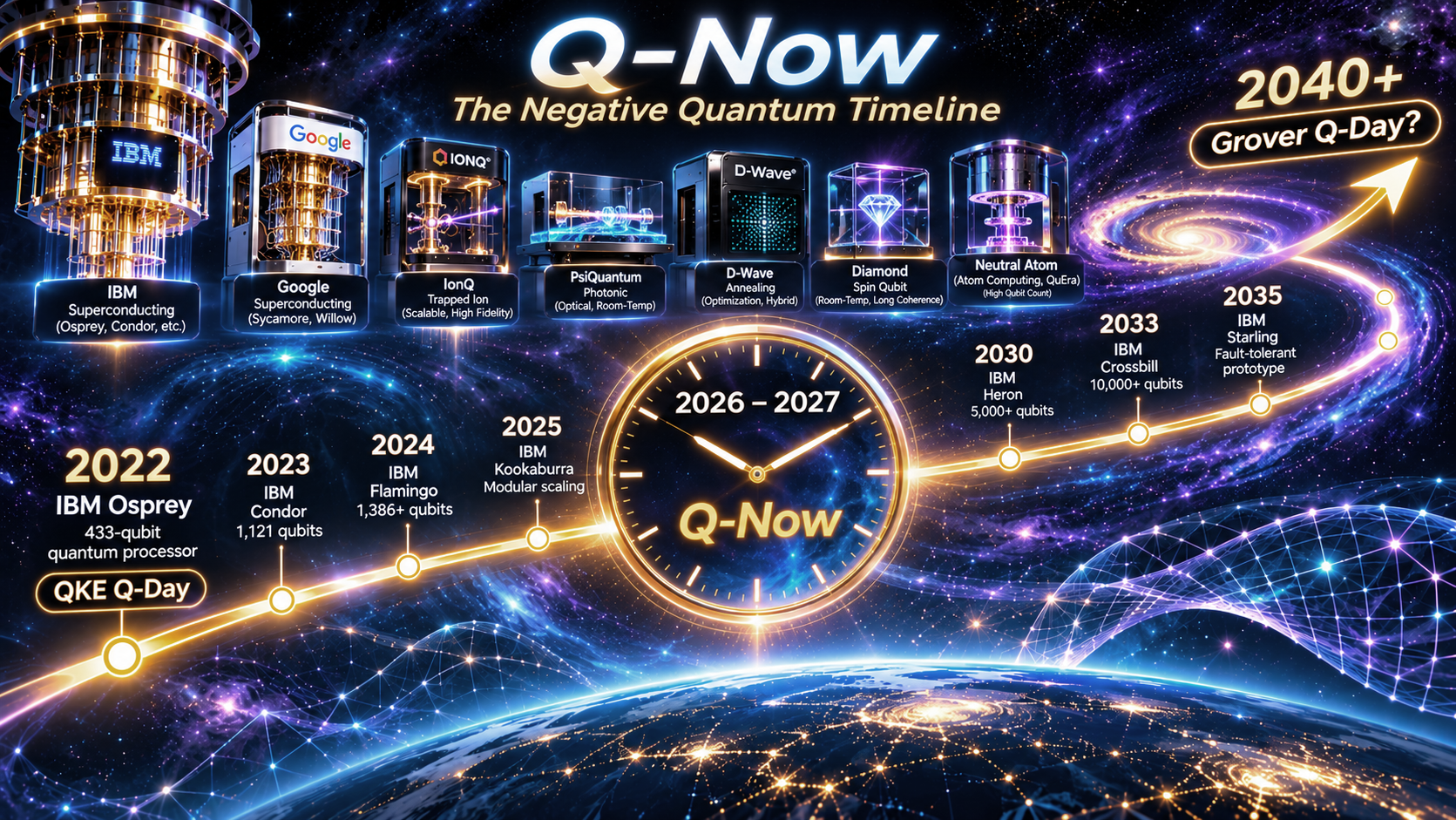
7. QKE Cryptographic Relevance Began in 2022
IBM Osprey · 2022
IBM Condor · 2023
These processors already exceeded the 256-qubit width of an AES-256 and ChaCha20 key register.
A full extraction circuit requires additional qubits and gates, but these facts change the quantum risk equation: could alternative QKE architectures operate on hardware far earlier than Grover-based forecasts suggest?
QKE search operates entirely in Superposition and ignores errors.
QKE therefore opens a retrospective quantum hardware risk investigation beginning in 2022.
Our R&D indicates the Q-Day countdown is negative, that is in the past.
8. The Most Valuable Capability in Digital Intelligence
Imagine any state intelligence agency acquiring the ability to extract AES and/or ChaCha20 keys from any ciphertext. Encrypted communications, corporate secrets and government intelligence would become instant targets on an globally catastrophic scale.
What would that agency gain by announcing the capability? It would invite the world to replace the very encryption upon which its advantage depended.
The strategic incentive is precisely the opposite: preserve the capability, preserve the secret, preserve the cryptographic dependency.
The value of the capability depends on the world continuing to trust the entrenched standard encryption.
Operational Q-Day and publicly acknowledged Q-Day are not the same event.
If the US has QKE capability it can explain why NIST failed to include AES in its Post Quantum Encryption program (PQE), declaring that AES-128, AES-192 and AES-256 are quantum safe.
Our R&D indicates that NIST has used Grover as a cover to justify AES exclusion from PQE.
If non-US states have also achieved QKE then we have a cryptographic arms race in progress where none of the states will reveal the fact. This is our theoretic explanation for the global escalation of cybersecurity breaches.
9. Is the Evidence Already in Front of Us?
Breaches. Hacks. Ransoms. Outages. Across different countries, industries and technology platforms, the reported escalation of incidents raises a question of common cause.
Conventional explanations must be examined at the point of initial compromise, not merely at the point where the damage became visible. A stolen credential, a malicious software insertion or a ransomware deployment may describe what happened after access was obtained. How was that access obtained?
The PORTALZ Breach Event Register brings the incidents and their reported causes together for independent examination. Its curated coverage is evolving; consistent historical coverage is essential to measuring the scale of any uptick.
Look beyond the individual incidents. Examine the pattern.
The Circumstantial Case
Two dominant algorithms. One shared security assumption - computational difficulty. A quantum risk lens centred on an impractical quantum search architecture. Practical alternative extraction research directions. QKE Quantum hardware milestones dating back years. An extraordinary incentive for QKE secrecy. And a growing register of cybersecurity incidents demanding explanation.
Q-Now brings these strands together to propose a possibility that future-oriented quantum preparedness cannot afford to overlook.
Why are we preparing for a distant and unlikely Grover Q-Day — when the QKE Q-Day is in the past?