New Cryptographic Art & Science
The Fractal Encryption Standard emerges from a New Cryptographic Art & Science whose foundations reside outside the orthodox classical cryptographic lexicon.
Classical encryption principally protects information by making unauthorised recovery computationally difficult. Its security is therefore bounded by the strength of its algorithms, the secrecy of its keys and the computational capability available to an adversary.
FES operates at a higher architectural order.
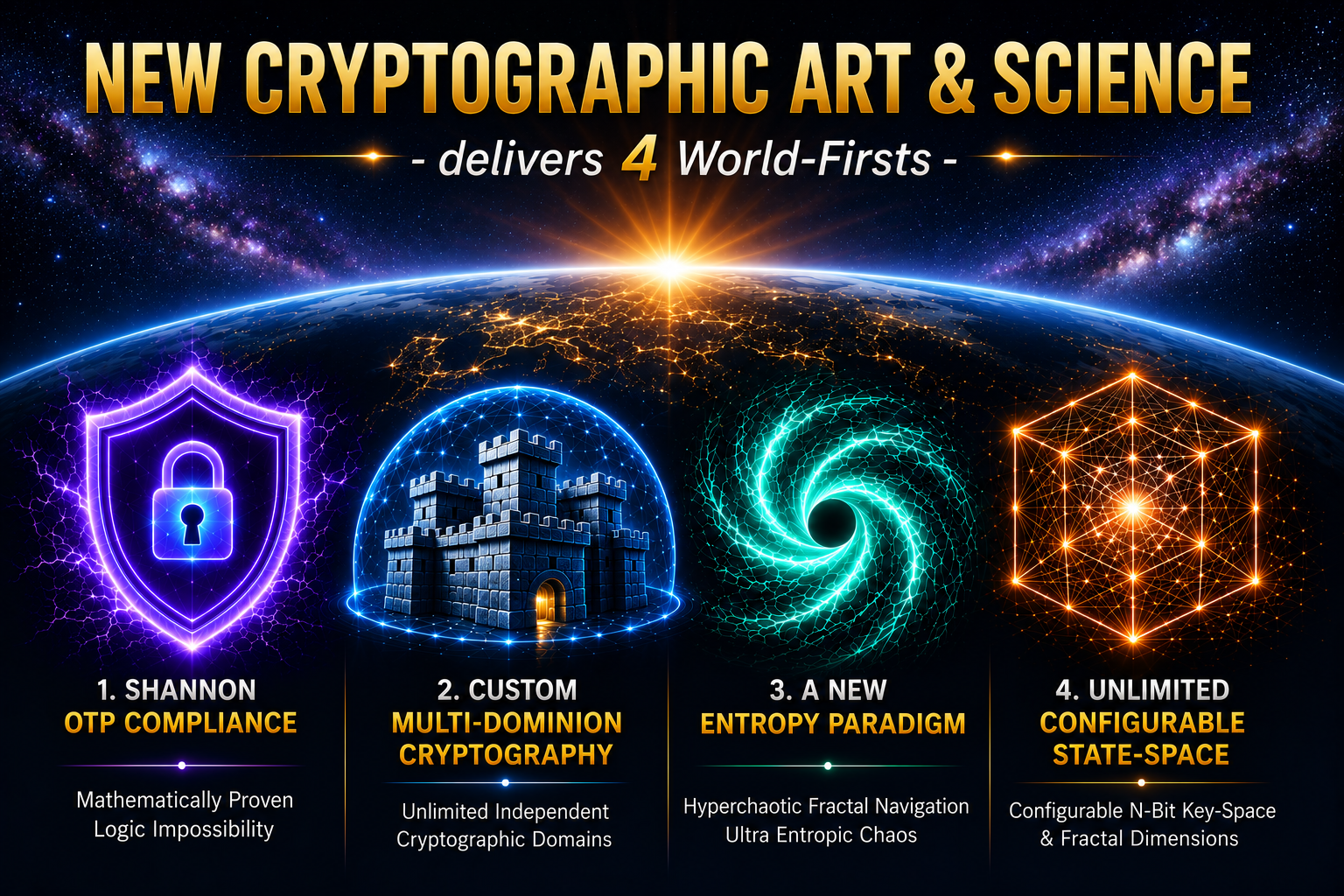
Rather than relying upon computational difficulty alone, FES combines Fractal Transformation, Hyperchaotic Fractal Navigation, Ultra Entropic Chaos, configurable multidimensional state-space, independent Silo cryptography and Dominion governance within a unified cryptographic platform.
Together, they define not merely a stronger form of classical encryption, but a new cryptographic architecture.

World First 1
100% Shannon OTP Compliance
Claude Shannon established the One-Time Pad as the classical standard for perfect secrecy. Its protection is not founded upon the time or computing power required to break a cipher. It is founded upon logical non-identifiability: the ciphertext does not uniquely determine an original plaintext.
FES achieves the three Shannon OTP tautologies through whole-of-payload transformation by a same-length fractal stream. Every same-length bit combination remains a viable payload candidate under a corresponding valid stream, leaving no uniquely privileged plaintext exposed for extraction.
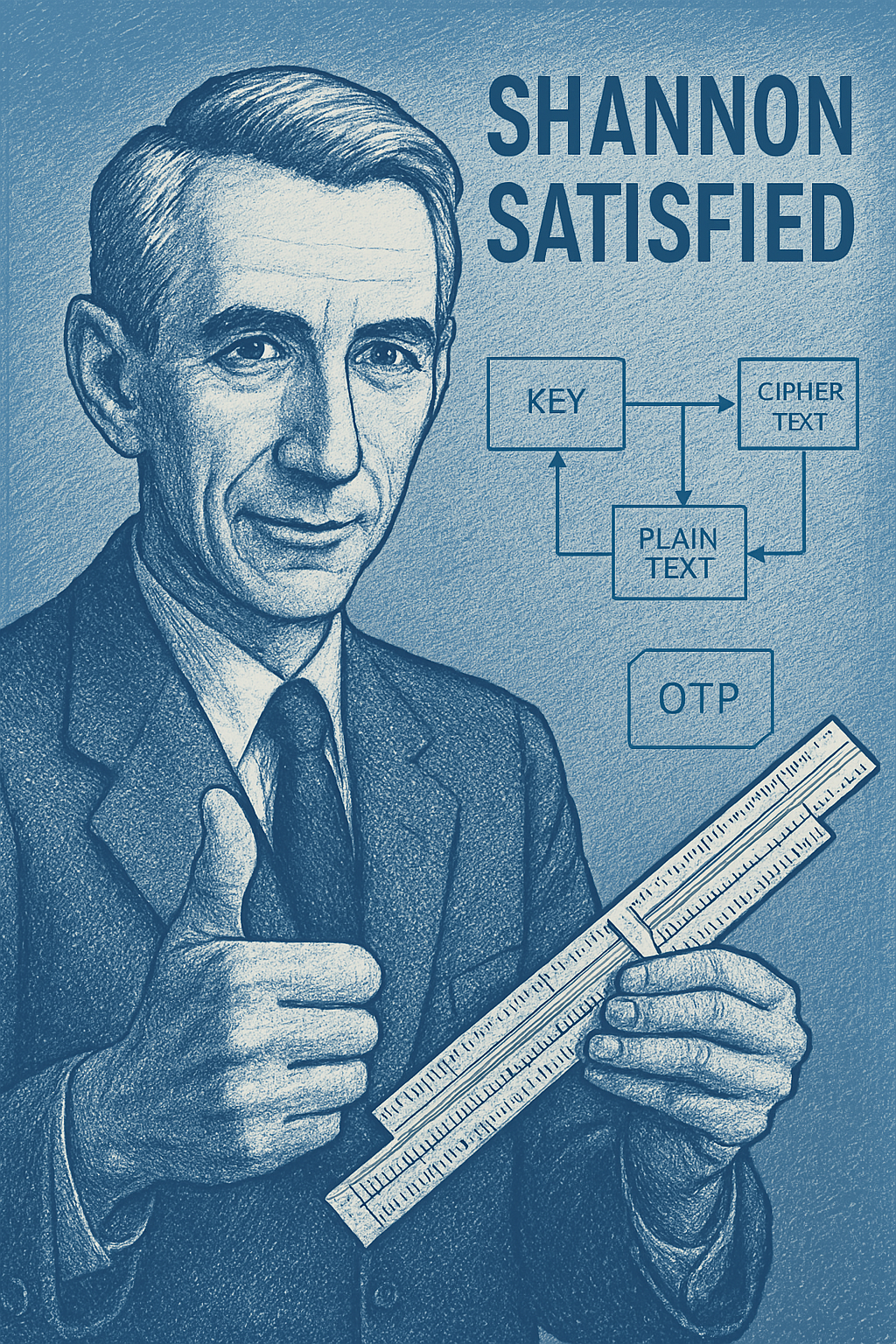
This places FES in the classical security class defined by Shannon while delivering that property through an entirely new deterministic fractal architecture.
The complete technical analysis, mathematical foundations, implementation details and supporting demonstrations are presented in the dedicated Shannon OTP Compliance page:
View the Complete Shannon OTP Compliance Analysis
World First 2
Custom Multi-Dominion Cryptography
Conventional encryption separates access primarily through keys. The underlying cipher remains common, creating a cryptographic monoculture in which keys move through applications, exports, backups, operators and infrastructure.
FES introduces cryptographic separation at the domain level. Dominion governance defines policy and hierarchy, while each Silo establishes an independent cryptographic universe with its own fractal mapping.
The same password used in two different Silos does not enter the same cryptographic domain and does not produce a related transformation. Cross-Silo keys have no cryptographic meaning.
Unlimited custom Dominions and Silos allow governments, organisations, divisions, projects, applications and individual data classes to operate within independently governed cryptographic foundations.

World First 3
A New Entropy Paradigm
Classical cryptography obtains entropy through deterministic pseudo-random generation or through physical sources of randomness.
FES introduces a third paradigm: Hyperchaotic Fractal Navigation.
HFN navigates the infinitely complex Mandelbrot domain via Fractal Portals and Fractal Derived Navigation. The resulting Ultra Entropic Chaos is deterministic and reproducible only through the exact FES context, yet exhibits the non-local divergence and complexity required for cryptographic transformation.
This new entropy architecture forms the dynamic cryptographic medium through which FES whole-of-payload transformation operates.

World First 4
Unlimited Configurable
State-Space
Conventional encryption standards are defined by fixed algorithmic structures with fixed key sizes. Their security space is selected from a small number of predetermined configurations, for example AES uses 128, 192 or 256 bit keys.
FES implements a proprietary Mandelbrot architecture that delivers an N-dimensional fractal domain. Each implemented dimension contributes 112 bits to the effective state-space, and the number of dimensions is configurable.
The minimum FES configuration begins at eight dimensions. The architecture has been tested to 40,000 dimensions, demonstrating that cryptographic dimensionality is not constrained to a fixed conventional ceiling.
Cryptographic depth can therefore be selected for payload, application, deployment and strategic security requirements, with no theoretical upper limit imposed by the architecture.
FES performance remains flat with increase in dimensions, there is no noticeable degradation for dimensions in the range 8 to 800 (896 to 89,600 bits).

One Integrated Cryptographic Platform
The four World Firsts are not isolated features. They are interdependent manifestations of one New Cryptographic Art & Science.
Shannon OTP Compliance removes reliance upon computational resistance as the sole security foundation.
Dominions and Silos replace cryptographic monoculture with independent governed domains.
HFN and UEC establish a new source and method of cryptographic stream emergence.
N-dimensional Mandelbrot state-space makes cryptographic depth configurable and unbounded by fixed key-size conventions.
FUNDAMENTALLY DIFFERENT.
LIMITLESS BY DESIGN.
Together, the four World Firsts establish FES as a new cryptographic platform rather than another encryption algorithm, cipher variation or key-management product.